Newspaper Article
Publication: Lancashire Evening Post
Date: Wednesday 3 November 1926
Title: Cardinal Bourne’s Visit to Blackpool
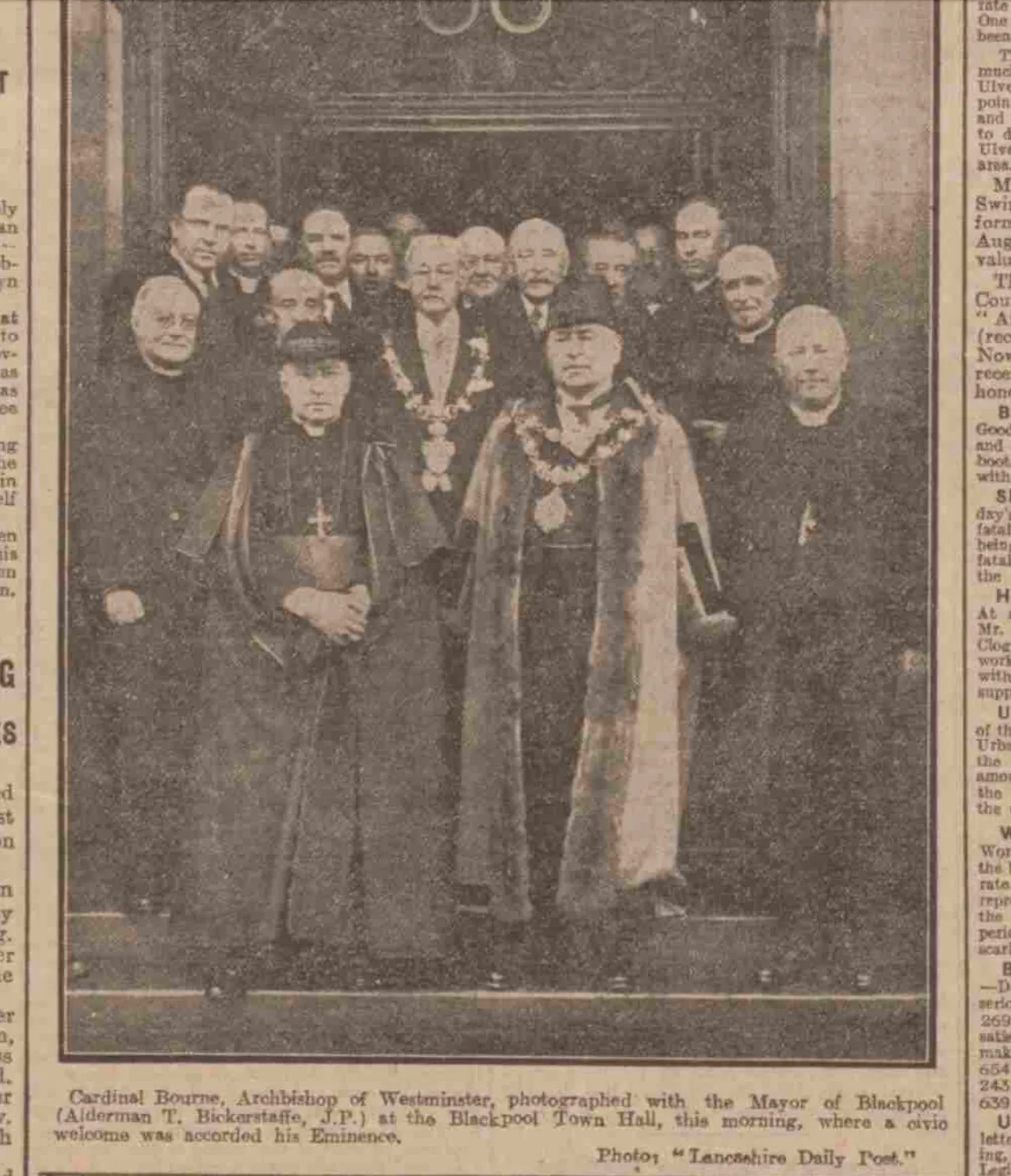
Much interest was evinced in the visit to Blackpool, to-day, of Cardinal Bourne, especially in view of the fact that a Catholic Cardinal has not visited the Fylde since the time of the Reformation. His Eminence had a busy day before him, for, starting at 11 a.m., when he was received by the Mayor (Alderman Tom Bickerstaffe) at the Town Hall, he was faced with a round of engagements extending until the early hours of to-morrow. After the civic reception the Cardinal was to be taken a motor tour of the borough, and, after lunching with the Mayor, open the extension of St. Joseph’s College, which is to serve the needs for secondary education of 16 Catholic parishes in the Fylde. From there a further motor ride had been arranged, and at 5:45 is to be entertained to dinner at the Tower Cafe. At 7:30 he will address a mass meeting of over 5,000 people in the Tower Ballroom, and will afterwards attend a dance arranged in honour of his visit by the Catholic Higher Education Committee.
Cardinal Bourne arrived at Preston from London by train last evening, and was met by Canon Lupton, of Blackpool, and Mr. McGlynn, the chairman of the Catholic Higher Education Committee, and made the rest of the journey by road.
RECEPTION CEREMONY
The Cardinal was met at the entrance to the Town Hall by members of the reception Committee, and was escorted up the main staircase to the Mayor’s parlour where he was received by Alderman Bickerstaffe.
Among those present at the reception ceremony were the Catholic Bishop of Lancaster, Sir John Bickerstaffe, the Mayor of Lytham St. Annes (Alderman Lightwood, Monsignor Pyke of Preston (Vicar-General), Canon Lupton (rector of St. Cuthbert’s, Blackpool), Father Moss (rector of Sacred Heart Church, Blackpool), Brother Hennessey (head of the Christian Brothers), Brother Leahy (head of the St. Edward’s College, Liverpool), Father McCullen, Brother Ford, Canon Blundell (Lancaster), Aldermen Broadhead, Mather, Collins, Fenton, Howe and Potter, as well as other representatives of the Blackpool Corporation; Mr. Draycott (treasurer of the Catholic Higher Education Committee), Mr. J. Daly (secretary of the committee), and other prominent local Catholics.
Extending a welcome on behalf of the town, the Mayor said he regarded the visit of the Cardinal, not as a personal honour, but as a general honour to the borough as a whole. He was sure that he was expressing the sentiments of the whole town when he referred to his Eminence as a great pillar of our national life.
THE FAME OF BLACKPOOL
Replying, Cardinal Bourne expressed his gratitude to the Mayor for his cordial reception and expressions of regard. ‘I know England north, south, east, and west,’ he continued, ‘fairly well, but this is the first occasion on which I have had the pleasure of visiting Blackpool. Wherever live we hear about this town. On every railway station in the Kingdom Blackpool and its attractions are made known to us, and we know what a health-giving, energy-bestowing factor in the life of the community, especially in the North of England, fills the air of your town.’
‘I am extremely glad that, at last, I have had this opportunity of coming. I am glad also that my coming should coincide with the jubilee of your incorporation as a borough which you are keeping this year. Those whom I specially represent, know, are doing their part in the civil life of the borough, and I am glad to hear further of the very close co-operation and cordiality that exists between all the various elements of civic life in Blackpool. Such a position of affairs should be welcomed and encouraged.’
‘I come here in connection with the extension of the new Catholic secondary school, a very important work—an important work for us Catholics, and I believe an important work also to the life of your town. I feel sure that your kindness and the words of welcome you uttered to me are a convincing proof and pledge that this Corporation’s activities will always be continued, both in our interests and in the interests of those others which it represents.’
A TRIBUTE TO THE MAYOR
The Bishop of Lancaster, on behalf of the Catholics of the Fylde, also thanked the Mayor for the manner in which he had received the first representative of Catholicism in England. ‘May I also thank you,’ he added ‘in a very personal way, for the interest you have taken in the preparations of this visit. I know from the first moment the matter was mentioned to you, you threw yourself heart and soul into the work.’
‘We, with the rest of our people, have rejoiced in your jubilee year, and we are only too sorry that, owing to various misfortunes, it was not possible to carry out all that was planned. We, as Catholics, were determined to join in the festivities, and do all that we could to make them a success. We have given you of our best. It will be one link joining us closer together, and I am sure that it will result in a more and more kindly spirit growing between us and other sections of the community.’
At the conclusion of the speeches the Cardinal signed the Town’s Roll, and after a group photograph had been taken on the steps of the Town Hall, he was taken for a tour of the town, accompanied by the Mayor.